Test challenge spurs New Zealanders
PART 6: New Zealand's 1937 cricket tour of England

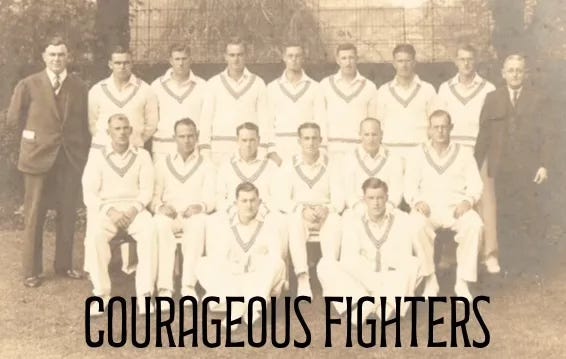
New Zealand could hardly claim to have set the cricket world on fire in the lead-up to the first Test at Lord’s – the 100th Test on English soil. Neville Cardus was scathing in his anticipation. He said nobody would expect Derbyshire to give England a good match, yet they were a better side than New Zealand. He said it was time the MCC set a limit on the number of occasions a player could earn an international cap. What concerned him more was that if Len Hutton scored a century on debut, it might lull England into a false sense of security ahead of the 1938 Ashes, while he wondered if an ‘overwhelming’ defeat would benefit the tourists. At the same time, by naming their strongest team of the moment, England could not afford to take chances in a game that would be a test for only one side.
The Telegraph’s Howard Marshall was a little more understanding, noting that New Zealand had not had the best preparation, had struggled to find an opening pair, and that their best players were not performing, leaving their confidence low. But he expected playing at Lord’s would lift them.
The New Zealanders are fighters. They will be at their best today. We have seen other teams improved out of all recognition by the challenge of the big occasion, and I fully expect that this will be true also of New Zealand.[1]
England batted first after winning the toss, but the early advantage was New Zealand’s. Jack Cowie thrived in the English conditions again, swinging the ball skillfully at his fast-medium pace. He bowled Len Hutton for a 25-minute duck and then picked up Jim Parks’ wicket, bowling him when he played back. But even when he was spelled, England failed to take advantage of Giff Vivian’s left-hand slow and the off-side line adopted by Alby Roberts. England struggled to dominate the tourists, Cardus carping that the batters did not help themselves to runs that should have been available. The tourists contained the home side, leaving Jack Hobbs to complain their scoring rate was too slow for a three-day Test. It was only when the bowlers tired that England took a toll, and they finished the first day at 370-7. In assessing the first day, E.W. Swanton said,
Almost everything the New Zealanders did was up to test standard. Even although [Walter] Hammond was out to collar the bowlers, they still bowled as they liked and not as he dictated.[2]
There were concerns about how the bowling constrained England before lunch on the first day, as the visitors’ lively fielding backed it up. Cardus said the home side’s play gave England supporters some idea of why they had lost the Ashes to Australia earlier in the year. What was little more than a ‘straight, good-length bowler was treated with ridiculous respect and portentousness’. Hammond and Hardstaff had been stroke-less, with Hammond scoring only seven in one half-hour. Hammond took a different view.
We batted first, and began rather badly, losing a couple of good wickets at the start for a handful of runs. Hutton in particular looked very surprised when Cowie brought the ball back amazingly to hit the off-stump. Hardstaff and I had to dig in and make some runs, and after a cautious beginning we both got centuries. I hit one big six, I remember, but the bowling was the sort it was never safe to take liberties with, and we had to go slow at times.[3]
Some critics accused England’s favourite batters of not enjoying Test cricket’s atmosphere. It seemed that merely saying ‘Test match’ caused them to lose all power of stroke play. The general view was that New Zealand was a distinctly inferior side, and while its bowling was sound, it could not be regarded as resourceful because it needed more genuine speed, leg spin or any spin. While Hammond (140) and Hardstaff (114) went on to dominate the scorecard, the New Zealanders’ attacking spirit and their bowlers’ keenness impressed more. Sadly, their fielding let them down, Hardstaff being dropped twice, and a stumping chance was missed off Hammond, all chances provided by Vivian. Cowie also impressed in his first spell of 12 overs, which produced 2-27.
Cowie’s first three balls to Hammond were venomous. Twice the great man was rapped sharply on the pads, and one at least he must have watched the umpire anxiously. Cowie then bowled one of his rare out-swingers to Hardstaff, and as the ball sizzled past the edge of the bat we felt that the gloves were really off.[4]
When England bowled on the second day after being dismissed for 424 with Cowie and Roberts taking four wickets each , the attack, which was always measured against how it might perform with Bradman’s batting, showed severe limitations, which New Zealand exposed after the lunch break when Kerr joined Wallace after recovering from an earlier blow. Hadlee, who had helped New Zealand recover from 37-2, was undone by a lifting ball from Bill Voce that Hedley Verity took in the gully on the last ball before lunch. Wallace hit Verity square for four and looked to attack him at every opportunity.
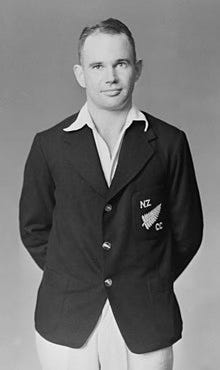
Alby Roberts
Verity bowled his slow, hanging, intellectual ball to Wallace, and Wallace, being obviously a man not skilled in abstract thinking, pulled for a huge six, and in the same over committed another solecism, a four to square leg. Wallace’s innings brought skill and character into the humdrum proceedings. A vehement sweep, which missed the ball by a yard, nearly gave Wallace’s wicket to Verity, and the next ball but one was crashed to leg – Wallace does not think before or after events but takes them as they come. How strange the influence on cricket of living purpose: before Wallace came in the match was a pretence and a bore. In quick time Wallace caused us to cease our irrelevant chatter and to watch all of his movements. Kerr rightly stone-walled with a short lift up of the bat. Wallace, like many of the aggressive people of the world, is not tall; there is the bark of the terrier in his cricket.[5]
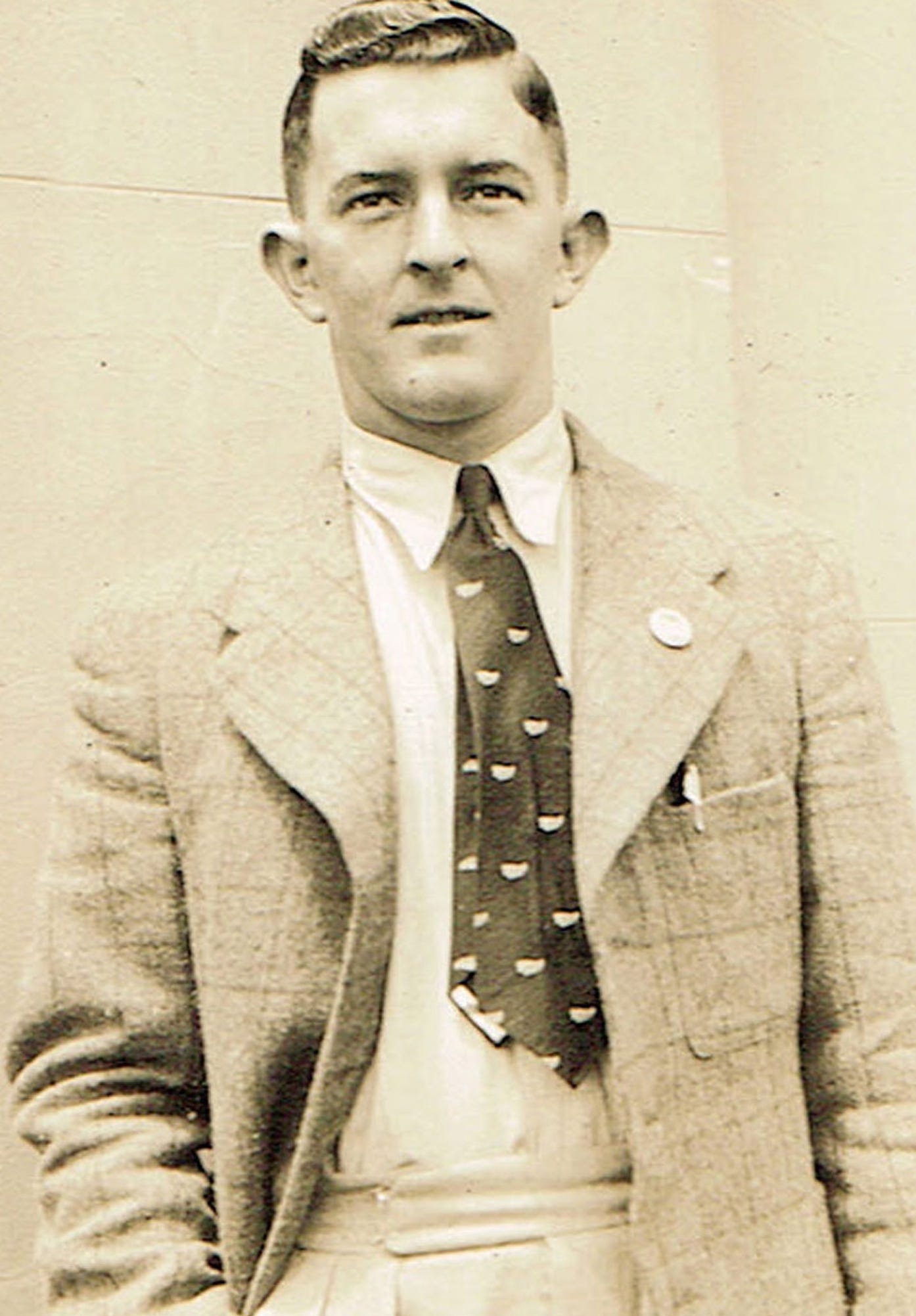
Merv Wallace
Donnelly recounted an amusing incident from Wallace’s innings.
In the papers [earlier in the tour], Jack Hobbs mentioned that Wallace had this dreadful shot where he played across the ball. This would be dangerous against a left-armer, and Wallace ought to cut it out. Well, for a time, Merv did remove it from his repertoire. But then we got to Lord’s for the first Test. Hedley Verity, the left-armer’s on. Merv gets into his ‘drop-kick’ position – that’s what we called his cross-batted shot – and Verity’s delivery went up into the clapping crowd for six. Merv suddenly thinks, ‘Christ, I’d promised not to play that shot.’ He trotted up to his partner at the other end: ‘Sorry Curly, I forgot’.[6]
Parks was brought on for his first spell when New Zealand was 119-3. Wallace drove him for three, and after Kerr took a single, struck the ball over the square-leg boundary for six to achieve his half-century. But, in his next over, Parks induced indecision from Wallace in playing back rather than going down the track again. Cardus was disappointed that the entertainment ended, saying it was better for a player like Wallace to be stumped than to be lbw. Donnelly joined Kerr but was lbw to Parks for a duck, leaving New Zealand 130-5. However, an eighth-wicket stand starting when ‘Sonny’ Moloney and Roberts were united with New Zealand 176-6, proved a highlight of the day. Once they saw off Alf Gover, they, by general media consensus at least, made the rest of the attack appear ordinary. As the runs mounted, home fans could only think, ‘If New Zealand can do this, what will Australia do next year?’ Once Moloney reached his 50, he hit Voce straight for four, leaving Cardus to say he threatened to compare with any of England’s batsmen for his ‘strong-mindedness and clean-edged skill.’ He went, caught and bowled by Verity for 64, while Roberts, after three minutes short of two hours, finished 66 not out in New Zealand’s total of 295.
Batting a second time, Hutton was missed in the slips before he had scored. However, Parks was not so fortunate, bowled by Cowie’s inswinger. But having taken 24 minutes to score one, Hutton touched another Cowie inswinger and was held by Vivian at short-leg. From 19-2, Joe Hardstaff (64) and Charlie Barnett (83 not out) took England to 123 before Hardstaff’s dismissal by Roberts, who 40 runs later also claimed Les Ames for 20. Captain RWV Robins added 38 not out before declaring at 226-4, a lead of 356 runs.
It was New Zealand’s game to lose, and when Hadlee was bowled by Voce for three, Moloney run out without scoring, and Vivian caught off Voce, it was 15-3 and perilous for the tourists. However, skipper Page was painstaking in staying 100 minutes while scoring 13 runs and leaving the attacking to Wallace, who continued from where he left off in the first innings. He attacked and, in 88 minutes, hit nine boundaries, but he fell once again lbw to Parks, this time for 56 as New Zealand slumped to 87-5. As Kerr settled in, Roberts batted 42 minutes for 17 before he was dismissed after 56 were added for the sixth wicket. Tindill went three runs later. Donnelly, batting at No.9, helped Kerr, who batted 104 minutes for his 38, to see New Zealand to stumps and a draw. It was an early signal from Donnelly that he possessed the right stuff, especially after his first innings duck. He was at the crease for 56 minutes and, given his earlier concerns with Gover’s bowling, two memorable hooks from his bowling showed he was feeling more comfortable in the arena. After a brief stoppage for bad light, he was dismissed in the final over of the Test, caught by Ames from Voce’s bowling for 21.
England’s critics immediately attacked their side. They acknowledged New Zealand’s effort in saving the game and denying England the win. Whether England actually deserved to win instead of draw is another matter: enough to say that their bowling was never deadly enough to achieve success, nor was it at various stages too well managed.[7]
The English perspective was about how the selected side might have done against Australia. And that was not warmly received. The Observer’s writer said England’s lack of fighting spirit allowed New Zealand off the hook. A Test match didn’t transform Cowie into Gregory, Roberts into O’Reilly or Vivian into Fleetwood-Smith, but that was how England batted in the first innings. Robins’ captaincy was eccentric, Ames’ wicket-keeping had lost its knack, while Verity, without help from the pitch, was only a run-checker, not a wicket-taker.
Of Cowie’s effort, the most heartening performance for New Zealand, one paper calculated that in a day’s bowling he ran 9000 yards, considerably more than an English bowler might expect. He bowled 56 overs in the Test, 41 in the first innings and 15 in the second. By comparison, Alf Gover bowled 40 (22 and 18) and Voce 42 (24 and 18).
NEXT: The tour’s first champion profiled
[1] Marshall, Daily Telegraph, 26 June 1937
[2] E.W.Swanton, Evening Standard, 27 June 1937
[3] Walter Hammond, Cricket My Destiny, Stanley Paul, London, 1946
[4] ibid
[5] Cardus, Manchester Guardian, 29 June 1937
[6] Martin Donnelly, quoted in Martin Donnelly by Rod Nye, HarperSports, Auckland 1999
[7] Frank Thorogood, News Chronicle, 30 June 1937