Something special brewing at Eden Park
History has provided memorable lessons

Circumstances, seen in the first two rounds of the Rugby Championship and in New Zealand's decision to host the first game against South Africa in Auckland, have conspired to make the contest one of the most keenly-awaited Tests for years.
New Zealand has built a massive unbroken run at Eden Park, a ground where South Africa has won only twice, in 1921 and 1937.
That 17-6 victory over the All Blacks in 1937 remains, despite higher scores that might have been posted elsewhere, when tries were worth more points, as one of the most painful in the rich history of New Zealand rugby.
The two earlier series between the sides were drawn, one win each and a draw in the decider in 1921, and two wins each in 1928.
But after a New Zealand win in the first Test of 1937, and a response from South Africa to win the second Test, the stage was set for the decider at Eden Park, in front of the biggest crowd, 50,000, to attend a sports event in New Zealand's history.
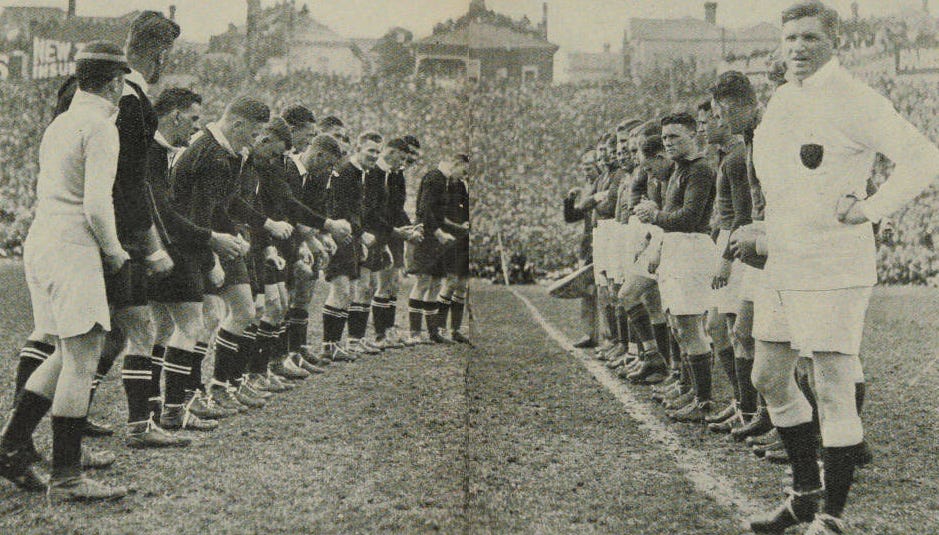
Awaiting the start of the third Test of their 1937 series, New Zealand and South Africa go through their pre-game formalities. Referee Joe King is at right. (Auckland Libraries Heritage Collections AWNS-19370929-51-02)
While the frequency of modern Test matches means not quite so much will rest on the September 6 encounter, there is still plenty to play for. The winner will go a long way to ensuring favouritism to take out the Championship for 2025, while the All Blacks have the goal of extending their record of 50 unbeaten Tests at the ground.
Just how devastating the 1937 loss was can be assessed by reactions at the time.
Mark Nicholls, the man who assured New Zealand of a drawn series with his outstanding fourth Test appearance in 1928, after having been overlooked for the earlier Tests, was a selector in 1937, and, unbelievably, a correspondent for Auckland's Weekly News.
He summed up South Africa's win.
South Africa today bestrides the Rugby world like a colossus – a pre-eminent position justly won and richly deserved. Playing magnificent rugby, her representatives outclassed the All Blacks in the final third Test match on Saturday, and they leave New Zealand with a match record unsurpassed by any other overseas team and a reputation for sportsmanship that almost makes me wish I was a South African.
The match was a triumph, both individually and collectively, for the South Africans. In each position, and as a team, the Springboks were immeasurably superior. And though New Zealand might deplore the fact that South Africa scored tries, as against the All Blacks' none, this measuring rod reflects truly the superiority of the visitors.[1]
What undid the All Blacks was the Springbok scrum. They unleashed an unforgettable lesson of the value of the three-fronted scrum, something New Zealand was still coming to terms with since it dropped the 2-3-2 scrum that sustained it until 1931.
Under the laws of the day, an opposing captain could opt for scrums instead of lineouts, and that was what captain Phil Nel did from the first chance he had at Eden Park. It was a tactic he had been sitting on all tour, and he chose his moment to unleash it.
He said he never forgot the impact his decision had on the All Blacks.
I held my hand, so far as making full use of our scrummaging ability, until that final Test. As a matter of fact, I was greatly tempted to use it in the match against Hawke's Bay, who were the last of the stiff provincial hurdles in the path of our making a clean sweep outside of the Test matches. That game at Napier was both rough and tough, and I felt the temptation to curb the ardour of our opponents by pinning them down in scrums.
But I acted wisely in not fully disclosing our hand. The result was that when the first lineout was signalled in the final Test match at Auckland, and we decided to take scrummages instead of lineouts, a look of bewildered astonishment came over the All Blacks, which I shall never forget as long as I live.
By the way, this brings me to the point that much of the captaincy of the All Blacks was done off the field. A whole system of tactics had been engineered and practised in secret by the New Zealanders. Much of it had to do with the policy to be employed during the lineouts. Of course, when we surprised the All Blacks by calling for scrummages, their whole tactical scheme came tumbling down like a pack of cards.[2]
Yet, referee Joe King was severe on his scrum rulings, penalising South Africa 22 times to eight for New Zealand.
To complement their scrum tactic, South Africa decided not to release the correct weights of the Springbok pack throughout the tour. When the side was selected to tour in April, the average weight of the 14 forwards was 207 lbs. But in New Zealand, the average increased by 10 lbs to 217 or 15st 7lbs per man.
The New Zealanders were completely knocked off their game by South Africa's scrum tactic. J.G. McLean, an older brother of T.P. McLean, wrote,
Another tragedy for New Zealand was that [Ron] King, the captain, did not have sufficient acumen to realise after the first ten minutes that every time the ball was kicked out by a New Zealander, except in a dire extremity, it needlessly provided one more scrum and so gave the Springboks almost certain possession. The one way to have combated the Springbok tactics would have been to keep the ball in play, to keep those big, massive forwards on the move, to bustle their backs as they waited for high kicks, and rely on pace as an offset to the South African's tremendous advantage in weight.[3]
While the All Blacks forwards were rendered helpless in the face of the South African tactics, the backs, diminished by injury to centre Brushy Mitchell, who should never have started, were reduced to spectators as South Africa's backs ran rampant with the possession they enjoyed. First five-eighths Dave Trevathan kicked away the only quality ball the All Blacks received.
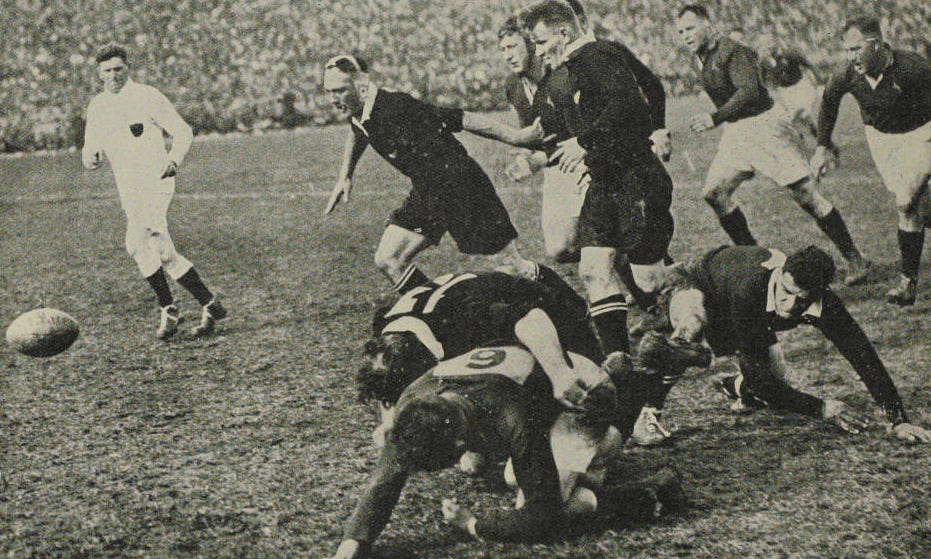
All Blacks Tori Reid and Arthur Lambourn chase the ball after a Springbok rush saw Lotz Brough down. Other Springboks pictured are Mauritz van den Berg, Boy Louw and Ebbo Bastard.(Auckland Libraries Heritage Collections AWNS-19370929-51-04)
A South African writer, possibly Sacks, wrote after the series win,
It seemed incredible that an All Blacks team could play so badly and be so completely mastered. The Springboks themselves must have been amazed at the ineptitude of the New Zealand inside backs, and astonished that a player of Mitchell's reputation could perform so indifferently, first at centre, then on the left wing. Right through the game, the left wing – Mitchell's win – was New Zealand's vulnerable point. Yet it was on Mitchell that New Zealand's greatest hopes were raised.[4]
In a report prepared for the Taranaki Rugby Union, Wellington referee Joe King, who refereed the second and third Tests of the series, said the South African players possessed knowledge and experience that was invaluable.
It was quite apparent to me that the Springboks had made a very careful study of the rules [sic – laws]. This is something all players should do. I don't mean that they should know all the rules off pat but each player should know thoroughly the rules which affect him in particular. For example, the hookers should make a study of all rules appertaining to scrummaging and hooking.
I think that you will also agree that their forwards played as forwards and their backs as backs, each keeping out of the other's way and performing their functions as rugby players should do.[5]
Graham Beamish, who covered the 1928 tour to South Africa, said the All Blacks were 'hopelessly outclassed in every department'.[6]
New Zealand was taught such a severe lesson today that should alter the whole trend of New Zealand football. They were taught, what they should have known, that a rugby team can be built on only one sure foundation. Possession of the ball is essential and there is only one way to get possession – that is from solid scrummaging.[7]
Record-breaking the crowd may have been, but the enthusiasm that greeted the All Blacks when they took the field soon dissipated. The crowd was as lifeless as the All Black pack was his summation.
South Africa scored after five minutes and was never challenged from that point.
At no stage of the game did the All Black forwards rise to the heights which they achieved in the first Test at Wellington; they were a lifeless, listless pack that achieved little. They were beaten in the scrums, they were beaten in the lineouts, and their effect in the loose was negligible.[8]
With all the possession they enjoyed from their scrummaging success, the South African backs had a field day.
D.H. Craven, with those magnificent long-range passes to T.A. Harris, [double rugby-cricket international for South Africa], made the South African backline. Craven played his greatest game of the New Zealand tour. Never before in the sixteen matches has he reached such dazzling heights. Throughout, his 15-yard passes, thrown with bullet-like precision, gave the South African backline a tremendous advantage. The job for Harris, who played brilliantly, was made easy. Neither flanker nor five-eighth could get near him.[9]
Nicholls took a similar view to Beamish on the inside backs. Craven was the best scrum-half in the world.
If I liked and appreciated any Springbok player more than another, Tony Harris was my particular pleasure. Up to this game, Tony has always seemed a fine player, but lacking in constructive genius; on this occasion, I could not fault him. He swung his backline into action with perfect rhythm, giving his outside man every opportunity to display his wares. He played to the blindside unexpectedly, swiftly, and with effect. He sensed the outcome of possible scoring opportunities and kicked to touch when he should have done so. He kept the All Blacks in a fever of suspense as to his intentions, and on every occasion when he parted with possession, whether by passing or kicking, it was to enhance his team's prospects of winning.[10]
King said the South African scrummaging was impressive for its detail.
The Springbok forwards never broke from the scrummage until told to do so, with the result that they made their opponents scrummage to the last second, thereby enabling the ball to get well away to the backs without quick-breaking forwards worrying them. If they saw that the opposing forwards were likely to break quickly, when they heeled the ball, they trapped it in the middle row and when the 'shiners' broke away looking for the ball, away went the heavy Springbok pack in a devastating forward rush, the balance of the opposing pack being unable to hold them.[11]
Nel, speaking at the post-Test dinner, said the Test had been a fitting climax to their tour and they were delighted to achieve something none of the predecessors had done. He said his side's play was influenced by the lessons the 1928 All Blacks had dished out on their tour. This was mainly in the intense backing up of the forwards and the 'magnificent handling' of the side.
Naturally, we still expected this to be one of the chief things in your football, but somehow you have lapsed in this direction. It is essential that forwards should be able to handle and back up intensely, as these factors bring about cohesion between back and forward play.[12]
When returning to South Africa, Nel said he was proud that the tour showed not only was the Springbok forward play as strong as it had ever been but its back play had been 'thoroughly re-established'.
We must not think because of what has happened, that we are world-beaters; we must never forget that the game does not stand still. But I can say that in the clash of two systems of football, the South African methods have been proven sound and successful, and that has been the foundation for the bright and open football that the side has been able to play.[13]
The 1937 Test, for all the reasons listed above, remains a special example of why Eden Park holds such a place in the All Blacks' game. That should be demonstrated again when the two side
[1] Mark Nicholls, NZ Weekly News, 29 September 1937
[2] Phil Nel, Springbok captain, interviewed by John Sacks on their return trip to South Africa. NZ Observer, 16 December 1937, p9
[3] J.G. McLean, NZ Observer, 30 September, 1937, p 9
[4] South African special correspondent, NZ Weekly News, 29 September 1937
[5] J.S. King, Report on Springboks for Taranaki Rugby Union, Southland Daily News, 23 April 1938
[6] Graham Beamish, Southland Daily News, 25 September 1937
[7] ibid
[8] Ibid
[9] Beamish, ibid
[10] Nicholls, ibid
[11] King ibid
[12] P.J. Nel, New Zealand Herald, 27 September 1937
[13] Nel, Manawatu Times, 11 December 1937