1981 Bok internal coaching discord described
Players took control to finish tour competitively

As the rugby world reflects on the power of South African rugby at the moment, especially the dominance of the double World Champion Springboks, it is worth reflecting on how far they have come since their return to the international fold in the post-apartheid era.
New Zealand knew better than most how the world finally turned on South Africa’s racial policies, with the high point of dissatisfaction registered during the controversial 1981 tour, the tour described as the only Civil War fought in this country, typically on the nation’s sports grounds
.
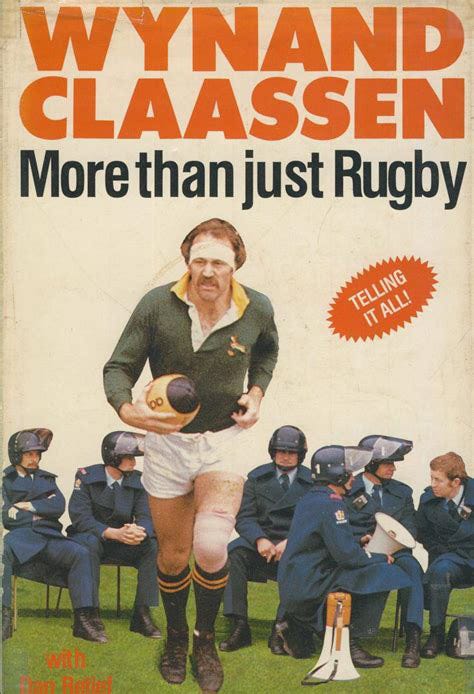
But a recent reading of 1981 Springbok captain Wynand Claassen’s autobiography reveals the depth of the South African mindset towards rugby, how his touring side overcame internal disruption, and the test of leadership and personal discipline the side’s front man faced.
Titled More Than Just Rugby, it presents a remarkable tale of internal dissent the side had to overcome before being denied a share of the three-Test series by referee Clive Norling’s decision-making – not the first time a series between the two was dictated by a referee!
In the prelude to the tour, of which Claassen was not assured of a place in the touring side, he explained the circumstances of his appointment. In the trials to select the side, he led the B team in one of the final games, a side that included only two players who had appeared against the British & Irish Lions a year earlier, wing Gerrie Germishuys and prop Martiens le Roux, while there were three earlier internationals also in the side.
The day before the final trial, Claassen called a practice where the side learned of his plan to take on the A team up front, their strong point. Claassen’s B team duly won 35-22, scoring six tries to two.
In post-match celebrations, the players learned they were not the first less favoured side to win such a game, and that the selectors’ view was that it was not a surprise, as B teams tended to be more motivated.
Before South Africa’s team was named to play two home Tests against Ireland, Claassen had one more chance to make an impression for his Natal side against Orange Free State in a key Currie Cup game. He led his side to a late win.
Later that evening, Claassen learned that not only had he made the Springboks side for the Irish series, but he had been appointed captain on debut. South Africa won both Tests, 23-15 and 12-10.
Delighted to be selected and appointed, Claassen admitted to wariness about his choice, especially given how convener Butch Lochner and fellow selector and team coach for the tour, Nelie Smith, an understudy at halfback to captain Dawie de Villiers on the 1965 tour to New Zealand, treated him afterwards.
The 1965 tour was the last time the Springboks had played on New Zealand soil, the 1973 visit having been cancelled by Prime Minister Norman Kirk, who had New Zealand’s hosting of the 1974 Commonwealth Games in Christchurch to consider.
Six weeks remained after the Ireland series before he could make the tour, and although suffering an injury in that interim, Claassen successfully proved his fitness for the New Zealand tour in a game in Durban.
However, another of the national selectors, Brian Irvine, asked for an urgent chat with him and said there were some facts Claassen should know.
He told me that both Nelie Smith and Butch Lochner had not wanted me in the team to play Ireland, as they felt the trials did not prove a thing. The muddled thinking which later was to become such a bone of contention between myself and Smith was even apparent then, for it seems that they conceded that I would captain the side to tour New Zealand, but that they wanted [Theuns] Stofberg for the Irish Tests![1]
Irvine and fellow selector Dougie Dyers had backed Claassen for the job and refused to bow to the demands of Smith and Lochner.
That evening, Irvine warned me not to trust Smith. He felt Smith had pre-conceived ideas about team compositions in New Zealand and that I did not fit into these plans. His parting shot was that Smith and I might become friends on tour, that we might even get along well and that I may even like him, but that I should not trust him – for my own good.[2]
After a long selection meeting there was a consensus that Claassen should be No8 and captain.
Smith apparently stood up and said he was not prepared to coach the team as it had been selected. As coach, he felt he should have the final say on the team’s composition. It seems that Prof. Daan Swiegers then told Smith that if that was his final word, he should resign immediately. The selectors would name another coach from within their ranks and inform Dr [Danie] Craven of developments. Smith yielded in the face of such resolve.[3]
But that didn’t stop Smith attempting to get his way before the selection was announced.
He telephoned the other selectors to try to get them to change their minds and even attempted to have another selection meeting called. Irvine, Dyers and Swiegers, refused, however.[4]
Before leaving for New Zealand, Claassen received a letter from 1965 Springbok tourist to New Zealand, Tommy Bedford, who expressed his best wishes for the tour, and he was confident Claassen’s team would have a better tour than in 1965, in spite of the fact that ‘the SAME scrumhalf [coach Smith] is again in the touring side’.
And then, after a pre-tour departure function with recently retired Springbok captain Morne du Plessis among the guests, Claassen asked if he could have a chat with him the next day.
He met me in my room the following morning and also advised me to be wary of Smith’s intentions. He said Smith liked to have his own way and would almost certainly push his favourite players...He told me to handle Smith firmly and to establish my authority as the captain early on.[5]
Claassen said it was clear Smith wanted to be able to claim a victory in the series through his methods, so he could claim a special place among South African coaches.
Smith left for New Zealand with only one aim in mind and that was to emerge as the new Markotter.[6]
He had a pre-conceived plan, in which I did not figure, with which to accomplish his dream. There were no other selectors to question or control him and I sometimes got the feeling he viewed me as a threat to the accomplishment of his ambition – even though I also wanted only to beat the All Blacks.[7]
Smith had allies in the media who were slipped stories to back his moves, while at selection meetings on tour, in which he was part of the tour committee, Claassen had to leave the room while the options for No8 were discussed.
Smith’s plans fell apart for four reasons, Claassen said. His team of ‘favourites’ lost the first Test in Christchurch, and he had no Plan B. He also under-estimated Claassen’s resolve and the support he had from his players. He underestimated the players’ ability to resolve their problems, and because of other incidents, he lost the players’ respect.
After the first Test, the team travelled to Greymouth to play the West Coast, and during a whole team meeting called by manager Johan Claassen, the skipper was asked to speak about maintaining unity because the Test series was still winnable. During his comments, skipper Claassen confronted Smith in front of the team, so there was no chance Smith could later claim that he was unaware of the players’ issues with him.
I said that the players urgently needed and expected feedback on their own performances to ensure the success of the tour. I told him the players were in the dark and feeling uncertain about their own abilities. To this, Smith replied that the captain expected feedback, but that the only feedback he could provide was that each player [should] search in his own heart and make an extra effort.
It was at this point that a number of the more senior players started to take control. We were tired of the management (especially Smith) treating us like children, and we made a decision to enjoy our tour more, meet more people and make more decisions for ourselves. There was a feeling of WE WILL MAKE THE TOUR![8]
After their meeting, they trained in Hokitika and were treated by local rugby people to a braai. The players let their hair down and Claassen said after clearing the air, he believed that day was when the tour was turned around and the players bond took over for the last half of the visit.
Once the tour was over, South African rugby supremo Dr Danie Craven asked Claassen for a private and confidential report on the tour. Claassen outlined several areas of conflict to Craven and later released the report in the book. Smith was dropped as coach and as a selector in 1982.
It defies belief that the Springboks were able to be as competitive as they were, not only because of the multitude of distractions they encountered but because of Smith’s premeditated approach to the tour. But Claassen’s control under challenging circumstances is a masterclass in leadership and provides a valuable record of what the Springboks endured on and off the field in 1981.
FOOTNOTE: Author Dan Retief later outlined another fascinating aspect of the book which was intended to be published around the time the All Blacks toured in 1985.
Hans Strijdom, a deputy editor of the SA Sunday Times, for whom Retief had written, had heard the 1985 All Blacks were going to ignore the decision of the New Zealand High Court to to forbid it taking place and sneak out of the country for the tour.
He decided to rush Claassen’s autobiography into print.
Retief explained,
One day I received a phone a call from him. ‘Come and fetch a copy of your book!’ he exclaimed.
What do you mean?’ I said.
‘It’s here with me; I’ve just received the advance copies. It looks fantastic!’ Fantastic indeed. Lying on my desk was a manuscript full of corrections in red ink, and he was telling me that the book had already been printed.[9]
[1] Wynand Claassen, More than just Rugby, Hans Strydom Publishers, Johannesburg, 1985, p 97
[2] ibid
[3] ibid
[4] ibid
[5] ibid
[6] ‘Oubass’ Mark Markotter enjoyed legendary status among South African coachs and preceded Danie Craven at Stellenbosch.
[7] ibid
[8] ibid, p.110
[9] Dan Retief, The Springboks and the Holy Grail, Zebra Press, Cape Town 2011, p.15
And sitting in that grandstand where that idiot protestor from Waiuk-way made his presence felt, thought the missing conversion by usually reliable and "deadly accurate" Naas Botha would have been a fitting end to the tour. Especially with what the Springboks had to endure. But no! Mr Clive Norling had to play up to the throngs and will be long remembered long before whatever dubious reason he promptly decided to award the penalty.
It is interesting to recall as told to me by a cousin of Hennie Muller the 1965 assistant-manager of the Springboks that toured Australia and New Zealand and revealed to us in front of notable journalist the late Dianne Haworth that Hennie Muller wanted Nellie Smith to be the tour captain but was over-ruled by the Broederbond elite that included in its support that of Dawie de Villiers. Admittedly Nellie Smith had led an unsuccessful tour of Ireland and Scotland prior to the Springboks coming to New Zealand but the Broederbond elite prevailed.